The Home Appraisal Is Getting a Major Makeover
Real Estate
Real Estate
New appraisal rules take effect November 2, 2026. Here's what changes, and what it means if you're buying or selling in Hot Springs.
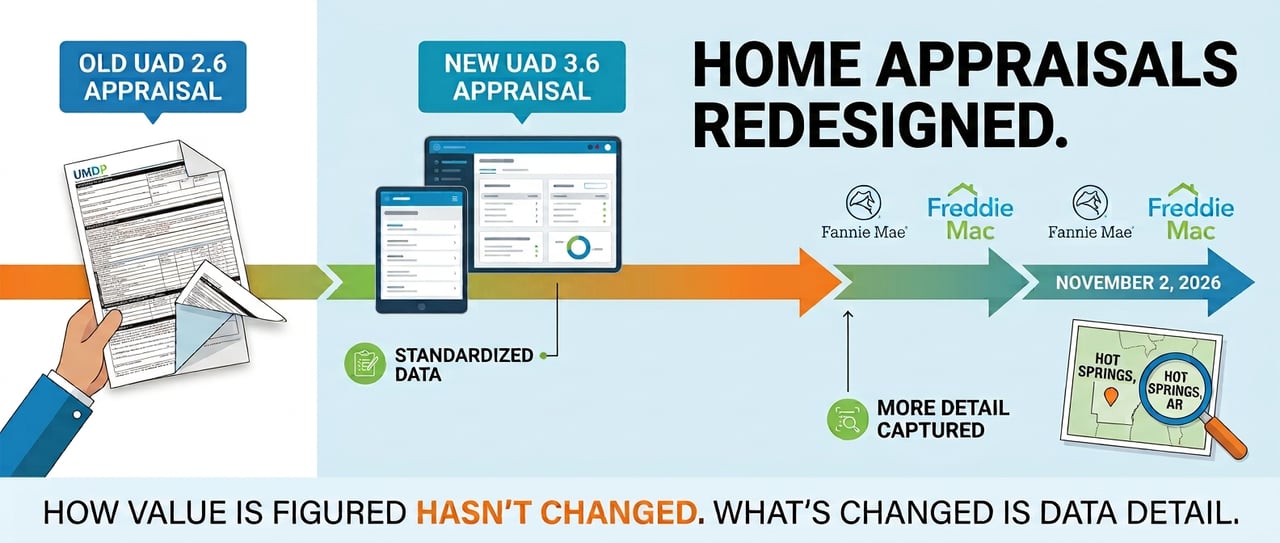
If you're buying or selling a home with a conventional loan, the appraisal you get after November 2 will look nothing like the ones we've seen for the last two decades. Fannie Mae and Freddie Mac are retiring the old appraisal forms and moving the whole industry from UAD 2.6 to UAD 3.6, the biggest overhaul of the home appraisal in nearly 20 years.
The short version: how your home's value is figured hasn't changed. What's changed is how much detail the appraiser has to capture, and it's a lot more.
UAD stands for Uniform Appraisal Dataset, the rulebook for how appraisers report data to Fannie Mae and Freddie Mac. Version 3.6 replaces the familiar Form 1004, the 1073 for condos, the 2055 and the rest with one dynamic report, the redesigned Uniform Residential Appraisal Report (URAR). It expands or shrinks based on the property type, the loan and the type of inspection. (NAMB)
The rollout has been gradual:
Date | What happened |
|---|---|
September 2025 | Limited production opened for early adopters |
January 26, 2026 | Broad production: any lender could use the new report |
November 2, 2026 | Mandatory for new appraisals on loans sold to Fannie Mae or Freddie Mac |
May 3, 2027 | Old format fully retired, even for revisions |
After November 2, a report in the old format submitted for a new loan is rejected outright. Revisions to an old-format appraisal already on file can stay in that format until May 3, 2027. (Freddie Mac)
FHA, VA and USDA loans aren't on the November 2 deadline. Those agencies are expected to move to the new format on their own schedules. (NAMB)
The old form had roughly 350 checkboxes and fields. The new report can call for around 2,000 data points, depending on the property. Instead of a short code or a sentence of commentary, appraisers now pick from standardized answers, field by field.
A few examples of how much bigger it is:
That means appraisers will likely spend more time at the property and may ask you, your agent or the seller more questions. Many in the industry expect turn times to stretch in the first weeks after the deadline, and fees may rise. (NAMB, Competitive Mortgage)
The upside: more structured data should mean fewer back-and-forth revision requests from underwriters, which is one of the most common closing delays today.
Here are some of the details the new report asks for that sellers and buyers should know about. (Epic Appraisal, Freddie Mac tips)
Feature | What the appraiser records |
|---|---|
Ceilings | Ceiling heights in the home |
Bathrooms and kitchen | Whether they've been updated, and how recently |
Roof | Estimated age |
HVAC and energy | Heating and cooling type, insulation, window performance and other energy-efficient features |
Solar panels | Whether the home has them, and whether they're owned or leased |
Waterfront | Access rights (deeded, by permit, etc.), feet of frontage, right to build, and water depth: deep, shallow or non-navigable |
Views | Type, how much is visible, and whether it helps or hurts value |
Internet | Whether broadband internet is available at the home |
Storm protection | Features like impact-resistant glass, storm shutters, fortified roofs or storm shelters |
Defects | Observable defects or deficiencies, often with a required photo |
The internet question is a new one. Broadband now sits alongside view, site and utilities as part of how a property is described. Appraisers have to confirm it's actually available to the home, not just to the street. (Appraisal Buzz)
Waterfront gets special attention. If the appraiser can't confirm access rights or water depth at the inspection, they're expected to look it up or ask. (Freddie Mac tips)
If your property has a guest house, mother-in-law suite or apartment over the garage, the appraiser has to decide whether it counts as an accessory dwelling unit (ADU). The new report captures more ADU detail and may require extra photos. (Epic Appraisal)
Under Fannie Mae's guidelines, an ADU must: (Fannie Mae)
The kitchen has to be a real kitchen. At minimum, that means a countertop, a sink with running water, and a stove or stove hookup. A hot plate, microwave or toaster oven doesn't count. A second kitchen on its own doesn't make a space an ADU, and pulling out the stove doesn't change the classification. (Fannie Mae)
Many cities and counties go further and cap an ADU at 50% of the main home's size, so local zoning matters too. One more thing for buyers: in most cases, you can't count rent from an ADU to help qualify for the mortgage.
If you're selling, have your home's details ready before the appraiser shows up. A little homework now can keep your closing on track:
If you're buying, plan for the appraisal to take a little longer than you'd expect, especially in November and December while everyone adjusts. Build some cushion into your contract timeline and stay in close touch with your lender.
On Lake Hamilton and Lake Ouachita, waterfront homes will get a much closer look. Shallow coves versus deep, navigable water, and whether your dock and frontage are deeded or permitted, are now specific line items, not just a note that the home is "on the lake." If you own a waterfront home here, it's worth knowing those answers now.
New rules can feel like one more hurdle, but they don't have to slow you down. If you're thinking about buying or selling in the Hot Springs area, I'll help you get your home's details in order so the appraisal goes smoothly.
Real Estate
New Rules Take Effect Nov 2, 2026



When you work with Jeff Kennedy and his team, you benefit from professionals who understand your needs and will work their absolute hardest to ensure excellent results for you and your family. Give Jeff a call today and discover the difference he can make for you!